
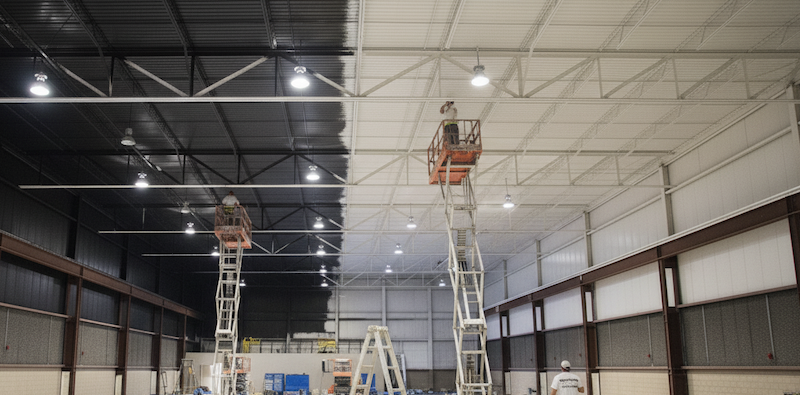
Discover how a small painting company won a $107K government contract without a proposal team.
How a 2-Person Painting Company Secured a $107K Government Contract
8 min read · Case Study

Peter has been running paint brushes across Denver for 25 years. He knows his craft cold. His crew shows up on time, his work is clean, and his residential clients keep coming back — year after year, project after project.
But over the past few years, something has been quietly shifting. Those loyal residential clients are calling less. Rising costs are eating into margins. And the work that used to carry the year isn’t carrying it the same way anymore.
Peter knew the answer was commercial work: larger contracts, government buildings, and projects that could fund months of payroll in a single award. He had even tried submitting RFPs before but never won a single one.
That changed when One of a Kind Painting submitted a bid for a commercial painting contract at the Colorado Convention Center in Denver — a city-owned facility spanning 70,000 square feet — and won a $107,000 contract that generated roughly $35,000 in profit in a single month of work.
This is the story of how they did it, what was different this time, and what it means for painting contractors who are ready to stop leaving commercial money on the table.
$107,000
Contract Value
~$35K
Profit in One Month
75%
Less Time Writing the Proposal
The Company: 25 Years of Craft, and a Business Model Hitting Its Ceiling
One of a Kind Painting is based in Aurora, Colorado, serving the greater Denver metropolitan area. Peter founded the business 25 years ago and has built it into a reliable residential operation — the kind that runs on word-of-mouth, repeat clients, and a reputation that takes decades to earn.
The business runs lean: Peter as the owner, a project manager who handles coordination on larger jobs, and a rotating crew of subcontractors — typically 2 to 4 people for residential work, and up to 10 for larger projects.
For most of its history, this model worked. But the economics of residential painting have shifted. Inflation has pushed up material costs, labor is more expensive, and longtime residential clients — the foundation of the business — are spending less or spacing out projects further apart.
Commercial contracts had always been on Peter’s radar. The math is simple: one commercial project can equal three to five months of residential revenue. The problem was never the painting itself; Peter’s crew could handle scale. The challenge was getting in the door.
The Hard Truth About RFP Season for Small Contractors
Government and commercial clients don’t evaluate contractors on their reputation alone. They evaluate proposals — formal written documents that demonstrate professionalism, project understanding, compliance awareness, and pricing transparency. A contractor who can paint perfectly but can’t write a compelling proposal doesn’t get a chance to swing a brush.
The Problem: Great Painters. Brutal Proposal Process.
One of a Kind Painting had tried to win commercial contracts before. They weren’t new to the RFPs but had read the documents, built their pricing, and submitted bids without success.
The issue wasn’t pricing; it was the proposal itself. Peter and his team are painters, estimators, and project managers — not proposal writers. Every time an RFP landed on their desk, the same painful process began:
- Studying the RFP — 1 to 2 hours reading through the document, trying to identify requirements, deadlines, and evaluation criteria.
- Analyzing and building the proposal — 3 to 4 hours of brainstorming, drafting sections, creating a price quote, and trying to organize everything into a coherent document.
- Finalizing and editing — 1 hour of corrections, formatting, and reviewing before submission.
Total: 5 to 7 hours per proposal attempt — hours pulled from an already full schedule of estimates, client calls, site visits, and project management.
Even after all that time, their proposals still didn’t look or read like the ones from established commercial contractors with dedicated proposal teams. They were functional but not competitive.
“We’d put in all that work and still feel like we were showing up to a gunfight with a pocket knife. You just knew when you submitted it that it probably wasn’t going to win.” — Peter, Owner, One of a Kind Painting
The Turning Point: A 70,000 Square Foot Opportunity
When the RFP for commercial painting work at the Colorado Convention Center arose, it looked like the kind of job that could change the year. The convention center — a landmark city-owned facility in downtown Denver — needed a full-building interior repaint: 70,000 square feet, one coat, consistent color throughout.
On paper, the job was straightforward: one coat, same color, and large open areas that a trained crew could navigate through efficiently. The math on the estimate was clean. The project was achievable.
But the bid process was formal. The city required a structured proposal response. Past experiences had taught Peter that submitting another rough proposal meant yet another loss.
This time, Peter used Proposio.
How Proposio Changed the Proposal Process for One of a Kind Painting
Proposio is an AI-powered proposal and estimating platform built specifically for small and medium-sized service businesses and contractors. Instead of spending hours trying to figure out how to structure and write their proposal, the platform reads the RFP, extracts key requirements, and generates a complete, professional proposal draft — tailored to the contractor’s information and the specific project details.
For One of a Kind Painting, the experience was immediate. The RFP was uploaded into the platform. Within minutes, the AI analyzed the document and identified key requirements, deliverables, scope details, and evaluation criteria the city would use to score responses. No more manual reading through dense government language.
From that structured analysis, Proposio generated a complete proposal draft — including sections covering company overview, project understanding, scope of work, methodology, crew qualifications, timeline, and pricing. The language was clear and professional, formatted according to commercial clients’ expectations.
What had previously consumed an entire day of stressful work was compressed into a fraction of the time — with a final output that looked polished and worthy of submission.
Proposal Time: Before vs. After Proposio
| Stage | Previous Process | With Proposio |
|---|---|---|
| Reading & analyzing the RFP | 1–2 hours | ~15 minutes (AI extracts key info) |
| Writing the proposal content | 3–4 hours | ~45 minutes (AI drafts, owner reviews) |
| Final edits & formatting | 1 hour | ~20 minutes |
Total: Before – 5–7 hours; After – ~80 minutes
“I couldn’t believe how fast we had something ready to submit. It looked more professional than anything we’d put out before. I actually felt confident sending it in.” — Peter, Owner, One of a Kind Painting
The Project: Colorado Convention Center, Denver

One of a Kind Painting was awarded the contract for a full interior repaint of 70,000 square feet across the Colorado Convention Center — a city-owned landmark used for major events, conventions, and public gatherings.
The scope called for a single coat application throughout, with consistent color across all surfaces. For a well-organized painting crew, it presented a job built for efficiency: large continuous surfaces, straightforward color requirements, and clear access staging.
Peter scaled his team up from the typical residential crew of 2 to 4 workers to a full crew of 6 to 10 people — adjusting weekly based on the area being worked and the convention center’s scheduling demands.
The communication with the city was professional and collaborative. Before work began, the team met with the client on-site twice to walk the space, confirm measurements, and understand logistical needs around storage access and building entry points.
Project Snapshot
- Client: Colorado Convention Center, Denver (City-owned)
- Project Type: Commercial interior repaint
- Square Footage: ~70,000 sq ft
- Scope: One coat, consistent color throughout
- Crew Size: 6–10 painters (subcontractors)
- Duration: Approximately 1 month
- Contract Value: $107,000
- Estimated Profit: ~$55,000
- Bidding Period: Approximately 2 weeks
The project came in on time. The client relationship remained strong throughout. The $107,000 contract — delivered in a single month — represented more than a third of the company’s entire previous annual revenue of approximately $180,000.

This contract marked a significant leap for One of a Kind Painting, elevating them from a residential focus to securing lucrative commercial work.
The Results: What One Contract Can Change
The numbers tell the story plainly. One of a Kind Painting’s average annual revenue before this project was approximately $180,000 — a result of 25 years of residential relationships.
This revenue required a full year of scheduling, estimating, managing crews, and delivering dozens of smaller jobs.
The Colorado Convention Center contract added roughly $107,000 in revenue and ~$55,000 in profit in a single month of work, reshaping the future of One of a Kind Painting.
As Peter reflects on this success, it underscores the importance of adapting to the changing landscape and embracing tools that streamline processes — ultimately enabling businesses like his to thrive in a competitive environment.
Leave a Reply