
Discover top resources for government contracts, from SAM.gov to local options, with step-by-step guidance for small businesses.
Where to Find Government and Commercial Contract Opportunities as a Small Business
Meta Description: Don’t know where to look for government or commercial contracts? Here’s exactly where to find bid opportunities — from SAM.gov to local portals to commercial platforms — with step-by-step instructions for small business contractors.
Target Keyword: where to find government contracts small business
Most small business contractors have the same experience: they hear that there’s a ton of government work available, they spend an afternoon poking around on the internet, they get confused by acronyms and websites that look like they were designed in 2003, and they give up. The work is out there — that part is true — but finding it requires knowing where to look and what to look for.
This guide lays it all out. By the end, you’ll have a clear, actionable list of exactly where to go to find contract opportunities at the federal, state, and local levels — and where to find commercial (private sector) B2B work too.
Federal Government Contracts: Start With SAM.gov
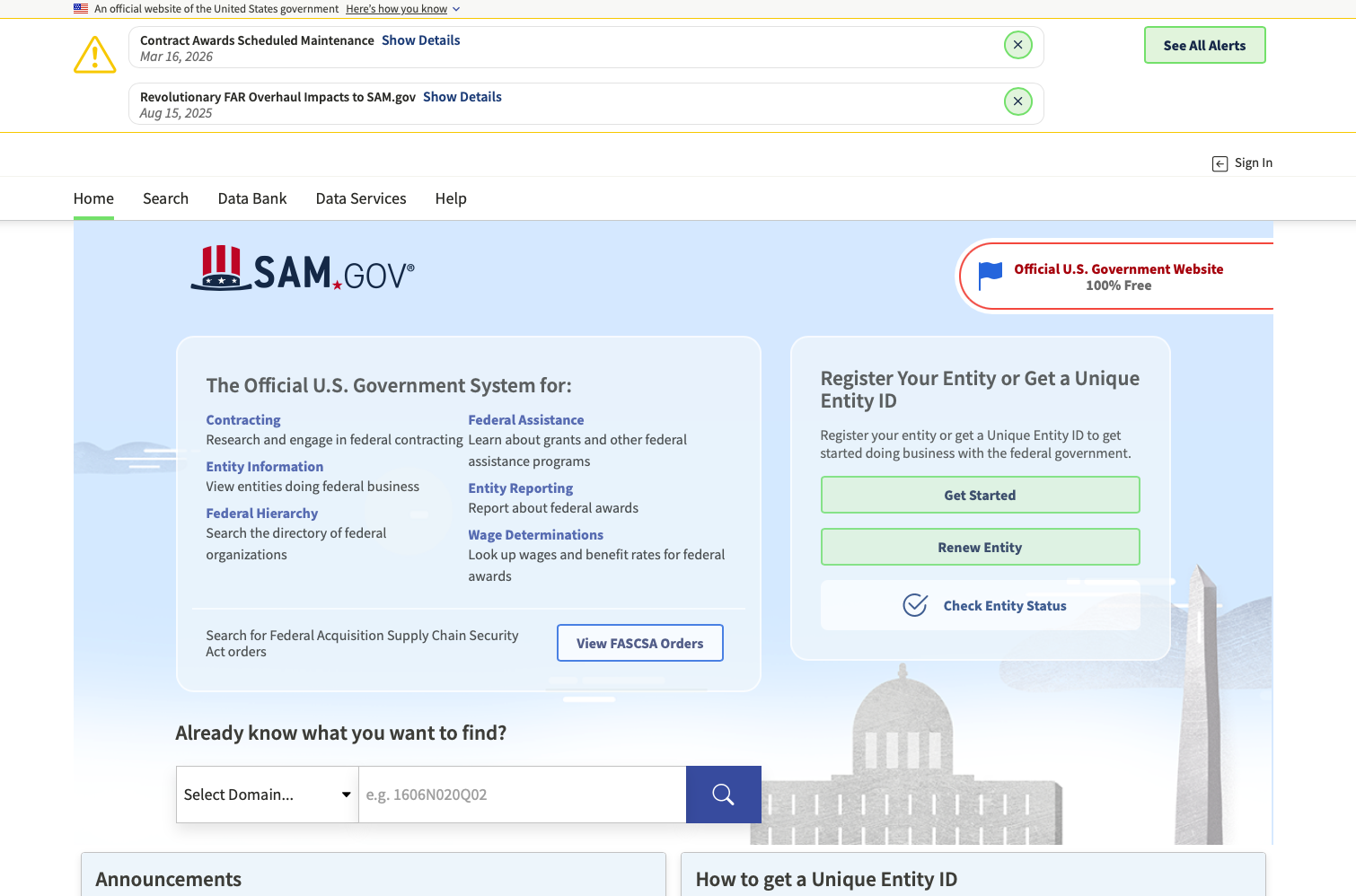
If you want to compete for federal government contracts, SAM.gov is where everything begins. SAM stands for System for Award Management, and it’s the federal government’s central database for two things: registering your business so agencies can pay you, and searching for open contract opportunities.
The contract search function at SAM.gov — officially called “Contract Opportunities” — lists all federal solicitations above the micro-purchase threshold ($10,000). At any given time, there are tens of thousands of active opportunities posted. You can search by keyword, NAICS code, agency, location, set-aside type, and solicitation type.
To search for opportunities, you don’t need to be registered. Anyone can browse. Registration is only required when you want to actually submit a bid. Registration is free, though it does require some setup — your business’s legal name, EIN, CAGE code, and some basic organizational information. Plan on spending about two hours to complete a first-time registration, and expect it to take up to two weeks for full activation. Once you’re in, your registration lasts one year and needs to be renewed annually.
Practical tip for SAM.gov: start your searches by NAICS code, not keyword. Keywords get noisy fast. Your NAICS code (or codes — you can register for multiple) filters results to the type of work you actually do. A painting contractor typically uses NAICS 238320. HVAC contractors use 238220. Landscaping falls under 561730. General contractors use a range of codes depending on the work. You can find your codes at census.gov/naics.
Set up saved searches with email alerts. SAM.gov lets you save a search and receive email notifications when new opportunities matching your criteria are posted. This is how serious contractors run their pipeline — they’re not manually checking every day. Relevant opportunities land in their inbox automatically.

USASpending.gov: Research What’s Already Been Awarded
Before you bid on anything, it’s worth spending time on USASpending.gov. This site tracks every dollar the federal government spends, including every contract award. You can search by agency, contractor, NAICS code, state, and contract type.
Why is this useful? Because it tells you exactly who’s winning the work you want to go after, what they’re charging, how long their contracts run, and how often those contracts come up for re-competition. If you’re a landscaping company and you want to bid on federal grounds maintenance contracts in your state, USASpending.gov will show you who currently holds those contracts, when they expire, and whether they’ve been won by small businesses before.
This is competitive intelligence that most small businesses completely ignore. Use it.

State and Local Government Contracts
The federal government gets most of the attention, but state and local government contracts are often easier to win — especially for contractors who are already operating in a specific region. A county government hiring a painting contractor for their facilities doesn’t need a massive national firm. They want someone local, reliable, and licensed.
Every state has its own procurement portal. Some are well-organized and easy to use; others are a bit harder to navigate. Here’s how to find them: search “[your state] state procurement opportunities” or “[your state] eProcurement.” Most states now have searchable online portals where all active solicitations are posted.
Beyond state-level contracts, don’t overlook cities, counties, school districts, public housing authorities, transit agencies, water utilities, and municipal hospitals. These are all separate entities with their own procurement processes, and many of them post opportunities on their own websites or through regional procurement portals.
Two platforms aggregate state and local opportunities worth knowing about:
- BidNet Direct (bidnetdirect.com) aggregates government bids from thousands of local agencies across the country. You can filter by trade, state, and opportunity type. They have a free trial.
- FindRFP (findrfp.com) is another aggregator covering federal, state, and local government RFPs across all industries, including construction, landscaping, HVAC, and maintenance services.
These tools save you the time of checking dozens of individual portals manually. Think of them as search engines specifically for government bid opportunities.

Commercial (Private Sector) B2B Contract Opportunities
Government work isn’t the only game in town. Large private companies — property management firms, commercial real estate developers, corporate campuses, hotel chains, retail chains, hospitals, universities — all hire contractors, and many of them use formal RFP processes to do it.
This is sometimes called commercial B2B contracting, and the dollar values can be substantial. A property management company managing 50 commercial buildings might put out a single annual contract for all their HVAC maintenance. A hotel group might run a competitive RFP for painting across their regional portfolio. A university might bid out five years of landscaping services in a single solicitation.
Where to find commercial RFP opportunities:
- The Blue Book (thebluebook.com) is one of the most established platforms for commercial construction and related trades. Contractors can find bid invitations from general contractors and owners across the US.
- Dodge Construction Network (construction.com) is widely used in the construction industry to track commercial project activity, from planning through award. Painting, HVAC, landscaping, and specialty contractors all use it to find GC-led projects to sub into or bid on directly.
- BuildingConnected (buildingconnected.com) — now part of Autodesk — is heavily used by general contractors to solicit bids from subcontractors. If you’re a specialty trade (painting, HVAC, landscaping), getting registered on BuildingConnected puts you in front of GCs actively looking for subs.
- ConstructConnect (constructconnect.com) is another large commercial construction bid network used across the industry.
For non-construction commercial work — like janitorial services, grounds maintenance, facility services — searching LinkedIn for procurement managers or facility directors at large companies in your area and reaching out directly is still one of the most effective approaches. Many commercial contracts are never publicly advertised; they’re awarded to contractors who are already in the buyer’s network. We’ll address how to break into that network in the next article.
Local Opportunities You Might Be Overlooking
Some of the most accessible opportunities for a growing small contractor are hiding in plain sight:
- Public housing authorities. Every major metropolitan area has a local or regional public housing authority (PHA) that manages hundreds or thousands of units. PHAs are federally funded and required to follow public procurement processes. They regularly hire painting contractors, HVAC companies, landscaping firms, and general contractors for both maintenance and capital projects. Search “[your city] housing authority procurement” to find your local authority’s bid listings.
- School districts. School districts hire contractors constantly — for HVAC maintenance, painting, grounds care, roofing, plumbing, and general repairs. Many districts have a vendors list or pre-qualification process that gets you approved for future work. Contact the facilities or operations department at your local district directly.
- Park and recreation departments. City and county parks departments maintain extensive grounds, facilities, and infrastructure. Landscaping and painting contracts through parks departments can be recurring and multi-year.
- Small Business Development Centers (SBDCs). These federally funded centers — located in every state and many cities — offer free consulting for small businesses pursuing government contracts. They can help you navigate registration, certification, and bidding. Find your nearest SBDC at americassbdc.org.
The Importance of Certifications
If you qualify for any of the following certifications, get them. They open doors to set-aside contracts that fewer businesses can compete for, which directly improves your odds of winning.
- The SBA’s 8(a) Business Development Program is for socially and economically disadvantaged business owners. 8(a) certified firms can be awarded contracts on a sole-source basis (no competition) up to certain dollar thresholds. The SBA’s website at sba.gov is where you apply.
- Women-Owned Small Business (WOSB) certification opens access to set-aside contracts in industries where women-owned firms are underrepresented.
- Service-Disabled Veteran-Owned Small Business (SDVOSB) certification provides access to set-aside contracts specifically for veteran entrepreneurs. The VA’s Vets First program and SBA both administer this.
- HUBZone certification is for businesses located in historically underutilized business zones.
By following this guide, you can efficiently navigate the complex landscape of government and commercial contracts and position your business for success.

Leave a Reply